By Mufti Faijullah Aman
Introduction
All praise belongs to Allah, the Lord of the worlds. May peace and blessings be upon our master Muhammad, who was sent as a mercy to all humanity, and upon his family and companions.
The world today is more connected and interconnected than ever before. Education, employment, trade, and technology have encouraged people to move between countries and cultures. As a result, Muslims are now present in almost every part of the world. Millions of Muslims today live in Europe, America, Japan, South Korea, and various countries across East Asia.
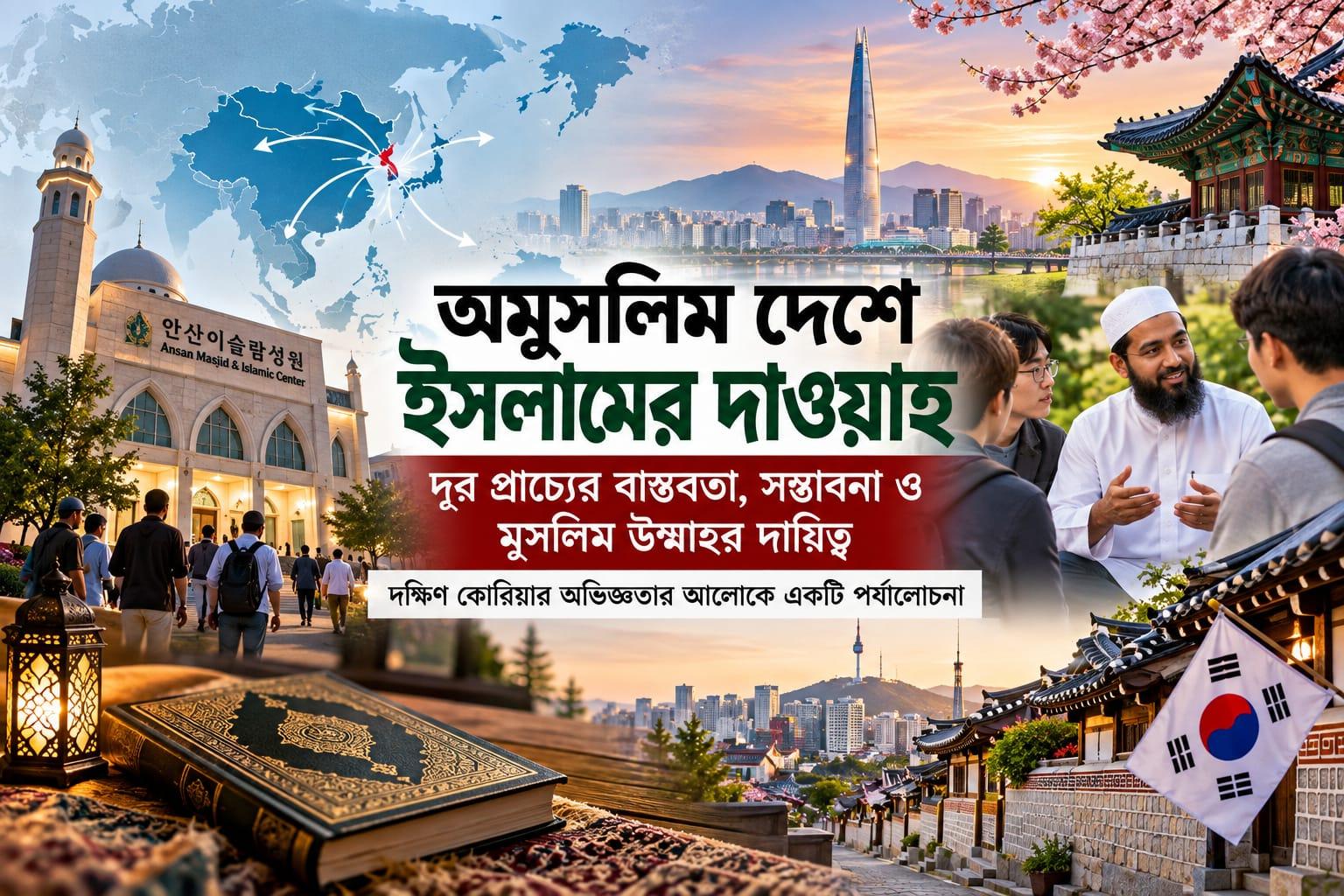
Regions that were once considered very distant from the Muslim world are now witnessing the establishment of mosques and Islamic centers, the teaching of the Qur'an, and growing interest among people who want to learn about Islam. South Korea is an important example of this contemporary reality.
Through my many years of working as an imam and da'i in South Korea, I have seen closely that many people genuinely want to know about Islam. They observe the lives of Muslims, ask questions about their beliefs, and pay attention to their character. In many cases, good manners, a sincere conversation, or the honest conduct of a Muslim can change the way people view Islam.
This highlights the importance of discussing Islamic dawah in non-Muslim countries. Islam is not a religion intended only for Muslims. Rather, it is Allah's message to all of humanity.
Why Did Islam Reach the Far East So Late?
From the very beginning of Islam, Muslims had a global outlook. The Companions carried the message of Islam beyond the Arabian Peninsula, and Islam reached Persia, the Levant, Egypt, Central Asia, and many other parts of the world.
However, an important historical reality is that China, Korea, and many other regions of the Far East did not become part of the political expansion of the Muslim world. This was due to a combination of military, diplomatic, and civilizational factors.
When the Sasanian Empire fell, its last ruler, Yazdegerd III, sent envoys to the Chinese Tang dynasty seeking assistance. At that time, China was a major power with an advanced civilization deeply influenced by Confucian thought. Emperor Taizong was known for his wisdom and foresight.
Some historical accounts suggest that after learning about the strength, discipline, and character of the Muslims and the Companions, the Chinese leadership preferred maintaining diplomatic relations rather than entering into direct confrontation with the Muslims. As a result, relations remained largely within the framework of limited communication and commercial and cultural exchange.
At that time, Korea was within the broader Chinese cultural sphere and was deeply influenced by Confucian thought. Consequently, the region remained outside the sphere of Muslim political influence for a long period.
Islam later reached these lands through trade, travel, and human relationships rather than through military conquest. Therefore, a strong Islamic civilization did not develop there in the same way that it did in the central regions of the Muslim world.
Today, however, South Korea, Japan, and other parts of East Asia represent a vast field for Islamic dawah. Many people there know very little about Islam, while at the same time an increasing number are searching for truth and spiritual meaning.
For this reason, the Muslim Ummah should reconsider the importance of this region and give greater attention to its intellectual and dawah potential.
Islam: A Global and Rapidly Expanding Religion
Islam is one of the world's fastest-growing religions today. This is not simply because of population growth among Muslims, but also because increasing numbers of people are embracing Islam in different parts of the world.
In Europe, America, and East Asia, many people are attracted to Islam for different reasons. Some are drawn to the belief in the oneness of God. Others are moved by Islamic ethics and spirituality. Still others become interested in Islam through their everyday interactions with Muslims and their conduct.
Among the major reasons for the growing interest in Islam in the modern age are:
1. Increased direct contact between Muslims and non-Muslims as a result of globalization.
2. The growth of social media and digital dawah.
3. Efforts to correct misconceptions about Islam.
4. The influence of Muslim character and humanitarian conduct.
5. The modern human search for spiritual meaning amid material and psychological challenges.
In South Korea, although Islam remains a minority religion, its presence has become more visible than before. This can be seen in several developments:
1. The presence of Muslim workers from many different countries.
2. The growing number of international Muslim students.
3. A gradual increase in the number of Koreans embracing Islam.
4. The growth of halal industries and services.
5. The spread of mosques and Islamic centers.
6. The emergence of Islamic content in the Korean language.
All of this demonstrates that Islam is no longer a religion confined to the Middle East or Muslim-majority countries. It has become an increasingly global reality.
Why Is Dawah Important in Non-Muslim Countries?
1. Presenting the True Image of Islam
There are many misconceptions about Islam in the world today. Media coverage, political conflicts, and international events have often shaped people's perceptions of Islam.
Therefore, Muslims have a responsibility to present the true nature, beauty, and ethics of Islam.
2. Conveying the Message of Islam to Humanity
Prophet Muhammad, peace and blessings be upon him, was sent as a mercy to all humanity. Therefore, conveying the message of Islam to different peoples and nations is a great responsibility upon Muslims.
3. Preserving Islamic Identity
Many Muslim children growing up in diaspora communities face the risk of cultural assimilation and becoming distant from their faith. Without strong Islamic institutions, mosques, educational programs, and proper upbringing, the younger generation may gradually lose its Islamic identity.
4. Building Coexistence and Human Relationships
Islam does not teach hatred. Rather, it teaches justice, mercy, and good treatment of people. Proper dawah helps build bridges of understanding and peaceful coexistence among people of different religions and cultures.
How Can Dawah Be Conducted in Non-Muslim Countries?
1. Dawah Through Character
This is one of the most powerful means of dawah.
The character of the Prophet, peace and blessings be upon him, attracted people to Islam. Even today, an honest, trustworthy, responsible, and kind Muslim can influence people more deeply than many speeches and lectures.
In Korean society, for example, people place great importance on practical behavior, discipline, and respect. Therefore, the conduct of Muslims directly influences how they perceive Islam.
2. Learning the Local Language
A genuine relationship with people cannot be built without understanding their language and culture.
Therefore, there is a great need today for Islamic books, educational content, lectures, and translations in Korean, as well as in other East Asian languages.
3. Making Mosques Open to Society
A mosque is not merely a place of worship. It is also a gateway through which people can learn about Islam.
When a mosque is clean, organized, welcoming, and open to visitors, it can become a powerful means of dawah.
4. Social and Humanitarian Activities
Dawah is not limited to words and lectures. It also includes:
- Blood donation
- Humanitarian assistance
- Community service
- Good relationships with neighbors
- Interfaith dialogue
These actions provide a practical representation of Islamic values.
5. Digital Dawah
In our time, social media has become one of the most powerful means of influence. Many young people may encounter Islam for the first time through the internet.
Therefore, producing high-quality Islamic content in local languages has become an urgent necessity.
South Korea: A New Gateway for Dawah
South Korea is one of the world's most advanced countries in technology, education, and economics. At the same time, however, Korean society faces significant psychological and spiritual challenges, including loneliness, family breakdown, social pressure, and the psychological stresses associated with a rapidly materialistic lifestyle.
Under these circumstances, many people are searching for spiritual meaning and inner stability. Here Islam can emerge as a balanced ethical and spiritual path.
We have witnessed this in reality. Many Koreans first visit mosques out of curiosity. They then begin learning about Islam, and some gradually become attracted to the beauty and values of the religion.
Cities such as Seoul, Ansan, and Busan have also developed diverse, multinational Muslim communities, creating new opportunities for dawah.
The Responsibility of the Muslim World
Dawah to Islam in non-Muslim countries is not the responsibility only of Muslims who live there. It is a responsibility shared by the entire Muslim Ummah.
If Muslim countries and institutions focus on:
- Supporting Islamic education
- Producing dawah content in local languages
- Training qualified da'is
- Supporting Islamic centers
- Developing halal industries and cultural engagement
then Islamic dawah can become stronger and more effective.
In particular, regions such as South Korea, Japan, and East Asia still offer vast opportunities for dawah. They require greater attention, strategic thinking, and a long-term vision from the Muslim Ummah.
Conclusion
Dawah to Islam in non-Muslim countries is not an impossible task. Rather, it is one of the great responsibilities of our time.
People today want to know about Islam. They observe Muslims, ask questions about their faith, and are influenced by their behavior and character. Therefore, every kind word, every good character trait, and every sincere human interaction can become a means of inviting people toward Allah.
Through my experience in South Korea, I have seen that people's hearts are still open to truth. What they need is a beautiful presentation of Islam, wisdom, and sincere character.
Perhaps Allah has willed that in our time, the message of Islam will reach and become established in regions that remained distant from it for many centuries.
We ask Allah to make us among those who call people toward goodness, to grant us sincerity and wisdom, and to enable us to carry the message of Islam to all humanity.
May Allah send peace, blessings, and mercy upon our Prophet Muhammad, his family, and all his companions.