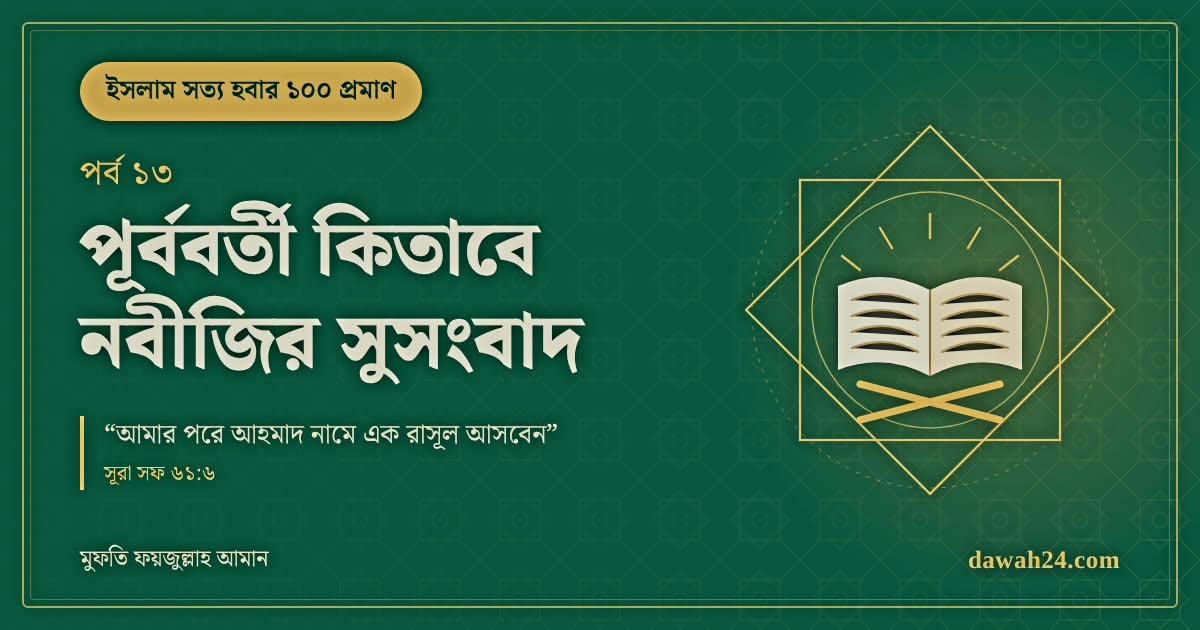
100 Proofs That Islam Is True (Part 13): The Prophet Foretold in Earlier Scriptures
Mufti Faijullah Aman
Introduction
The Prophet (peace be upon him) never claimed to invent a new religion. He said he was the last prophet in the same line of prophethood in which Abraham, Moses, and Jesus (peace be upon them) came. More than that, he claimed that earlier prophets had given good news of his coming. This was a claim that the people of his own time had every opportunity to test.
The Claim of the Qur'an
Allah says: "Those who follow the Messenger, the unlettered Prophet, whom they find written in what they have of the Torah and the Gospel." (Surah al-A'raf 7:157)
He also says: "And remember when Jesus, son of Mary, said: O Children of Israel, I am the Messenger of Allah to you, confirming the Torah that came before me, and bringing good news of a Messenger who will come after me, whose name is Ahmad." (Surah as-Saff 61:6)
And about the scholars of the People of the Book, He says: "Those to whom We gave the Scripture recognize him as they recognize their own sons." (Surah al-Baqarah 2:146)
Before Whom Was This Claim Made?
This deserves deep thought. In Madinah at that time lived three large Jewish tribes, among whom were great scholars of the Torah. Nearby was the Christian community of Najran, and to the north, in Syria and Rome, was a vast society of Christian clergy.
If no such prophecy existed in their scriptures, proving the Qur'an false would have been very easy. They would simply open their books and say: show us where it is written. A false claimant would never make a claim that his most learned opponents could refute with books in their own hands.
What Is Found in the Bible
Even after centuries of translations and changes, the Bible still contains certain passages that Muslim scholars see as pointing to the Prophet.
1. A Prophet Like Moses
In the Torah, God says to Moses: "I will raise up for them a prophet like you from among their brothers, and I will put My words in his mouth, and he will tell them everything I command him." (Deuteronomy 18:18)
Muslim scholars note several points here. "From among their brothers": the brothers of the Children of Israel are the descendants of Ishmael, that is, the Arabs. "Like you": like Moses, the Prophet Muhammad was at once a prophet, a lawgiver, a leader of a state, and a commander; he too had a natural birth, marriage, and death. "I will put My words in his mouth": the Prophet himself could not read or write; the words of God were placed in his mouth, and he delivered them exactly.
2. The Comforter, or Paraclete
In the Gospel of John, Jesus (peace be upon him) says: "I will ask the Father, and He will give you another Helper (Paraclete), to be with you forever." (John 14:16) He also says: "He will not speak on his own; he will speak only what he hears, and he will tell you what is yet to come." (John 16:13)
Christians generally understand this to mean the Holy Spirit. But Muslim scholars point out that this description, "he will not speak on his own; he will speak only what he hears," matches exactly the verse of the Qur'an: "He does not speak from his own desire. It is nothing but revelation sent to him." (Surah an-Najm 53:3-4) And "another Helper" who will remain "forever" refers to the final prophet, whose teaching will last until the end of time.
3. From the Mountain of Paran
The Torah says: "The Lord came from Sinai, rose upon them from Seir, and shone forth from Mount Paran." (Deuteronomy 33:2) In the explanation of Muslim scholars, Sinai is the place of revelation to Moses, Seir is toward Palestine, the region of Jesus, and Paran is the wilderness where, according to the Torah, Ishmael lived (Genesis 21:21), which Muslim scholars identify with the region of Makkah.
Those Who Recognized Him and Believed
The greatest testimony is the position of the scholars of the People of the Book in that very era.
Abdullah ibn Salam (may Allah be pleased with him) was the most respected scholar among the Jews of Madinah. When the Prophet arrived in Madinah, he went to see him, asked him several questions, and accepted faith. He said that as soon as he saw the Prophet's face, he knew it was not the face of a liar. (Sunan at-Tirmidhi; the questions are in Sahih al-Bukhari)
Salman al-Farisi (may Allah be pleased with him) left his fire-worshipping family in Persia and went in search of truth from one Christian monk to another. Before dying, his last teacher told him that the final prophet would appear in a land of date palms in Arabia, and that he would bear certain signs. By matching those signs, Salman recognized the Prophet in Madinah. (Musnad Ahmad)
The Najashi, the Christian king of Abyssinia, wept when he heard the Qur'an's account of Mary (peace be upon her), and said that this message and what Jesus brought came from the same source of light. He later embraced Islam, and when he died, the Prophet led the funeral prayer for him in absence in Madinah. (Sahih al-Bukhari)
And the Roman emperor Heraclius, mentioned in Part 4, said after questioning Abu Sufyan: "I knew that this prophet was coming, but I did not think he would come from among you." (Sahih al-Bukhari)
Why Is This a Proof?
The Prophet made a claim that the Jewish and Christian scholars of his age had the greatest power to refute. Some of them denied it, but many of the most knowledgeable and sincere among them recognized him and believed. Would the finest scholars of rival religions have acknowledged a false claimant in light of their own scriptures?
Conclusion
The prophets in the line that began with Abraham (peace be upon him) gave good news of the prophet to come. Muhammad (peace be upon him) is the fulfillment of that good news. He did not bring a new truth; he completed the eternal truth brought by all the prophets.
In the next part, the fourteenth proof, in sha Allah.