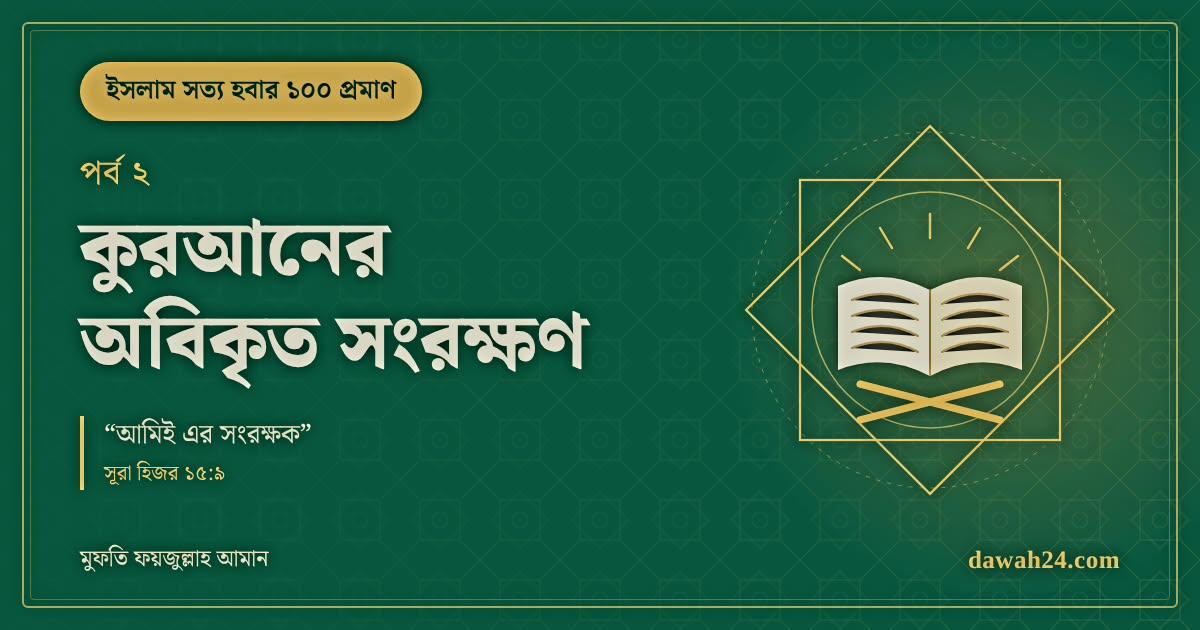
100 Proofs That Islam Is True (Part 2): The Perfect Preservation of the Qur'an
Mufti Faizullah Aman
Introduction
If a book is truly the word of God, it must reach people without any change. Otherwise, how would anyone know which words are from God and which were added by human beings? The Qur'an answers this question in a way that has no equal in the history of the world.
Allah's Announcement in Advance
Allah says: "Indeed, it is We who sent down the Reminder (the Qur'an), and indeed, We will be its guardian." (Surah al-Hijr 15:9)
He also says: "Falsehood cannot approach it from before it or from behind it. It is a revelation from One who is All-Wise, Worthy of all praise." (Surah Fussilat 41:42)
Think about this: this announcement was made at a time when the Muslims were weak, few in number, and surrounded by enemies. No human being at that time could have been certain that this Book would survive even a few years. Yet today, fourteen hundred years later, we see that the announcement has come true, letter by letter.
Two Ways of Preservation: In Hearts and on Paper
The Qur'an has been preserved in two ways at the same time.
First, through memorization. The Prophet (peace be upon him) himself memorized the Qur'an and taught his companions to memorize it. Every Ramadan, he reviewed the entire Qur'an with the angel Jibril. That tradition continues to this day. There are millions of memorizers (huffaz) in the world now, many of whom do not even understand Arabic, yet they can recite the entire Qur'an without error, from the first letter to the last. If every printed copy of the Qur'an disappeared tomorrow, the memorizers could write it out again, exactly as it was, within hours. This is unimaginable for any other scripture.
Second, through writing. As soon as revelation came, scribes among the companions wrote it down by the Prophet's instruction. During the time of Abu Bakr (may Allah be pleased with him), the entire Qur'an was compiled into a single volume under the supervision of Zayd ibn Thabit (may Allah be pleased with him). Later, Uthman (may Allah be pleased with him) prepared standard copies from it and sent them to different regions.
The Witness of the Manuscripts
Modern science also bears witness to this preservation. In 2015, some ancient pages of the Qur'an kept at the University of Birmingham in the United Kingdom were radiocarbon tested. The results showed that the parchment came from the lifetime of the Prophet or very close to it. And the text on those pages matches the Qur'an we read today. Other first-century manuscripts in museums around the world give the same testimony.
A Comparison with Other Scriptures
The original copies of the earlier revealed scriptures in their original languages no longer exist. Their various versions differ from one another, and scholars of those religions themselves debate which parts are original and which were added later. The Qur'an, however, is still read today in Arabic, the language in which it was revealed, with the same words and in the same order. Whether you go to Dhaka, Seoul, Cairo, or London, there is only one Qur'an.
Conclusion
Let the sincere seeker reflect: how could a man in the desert of the seventh century be certain that the Book he brought would remain unchanged until the end of time? And how did it actually remain unchanged, while every other ancient book in the world has suffered alteration? The only explanation is that its Guardian is Allah Himself, and it is He who sent it down.
In the next part, the third proof, in sha Allah.